

Quick answer: Nearly half (47%) of UK small businesses now use AI tools, up from 22% in 2025, according to Simply Business’s 2026 SME Insights Report. But confidence hasn’t kept pace – just 19% describe themselves as ‘very confident’ using AI day to day, pointing to a widening gap between adoption and understanding.
New research from Simply Business has found that AI adoption among UK small businesses has surged over the past year. Almost half (47%) of small business owners now use AI tools – more than double the 22% recorded in 2025.
And a further 13% plan to start within the next six to 12 months, meaning six in 10 are either using AI now or will be shortly.
These findings come from Simply Business’s 2026 SME Insights Report, a survey of 1,842 UK small businesses.
But this data also reveals a more complicated picture: widespread uptake hasn’t translated into widespread confidence. And for many small businesses, the question is no longer whether to use AI – but how.
How are small businesses using AI?
Among those already using AI tools, the most common applications are creating content (63%), problem solving (53%), and generating ideas (50%). And for 46%, AI is currently helping to save time on admin.
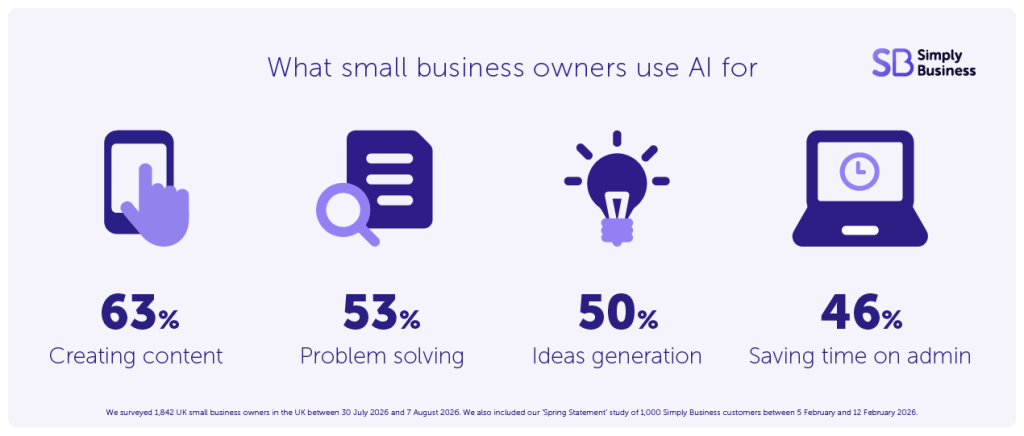
Those uses help show the practical pressures small business owners are facing. Small business owners often juggle many roles and can struggle to find the time to give to each of them. Any tool that cut down on repetitive tasks or help manage cash flow and planning carries real appeal.
Fay Phillips-Jones, Founder and HR Career Coach at Coaching With Fay, is one of many sole traders who’ve found AI genuinely useful. She said: “AI has played an important role in accelerating my business. As a sole founder, I use it to challenge my thinking, support business planning, organise information, and develop more efficient systems. However, I treat AI as a thinking partner, not a substitute for thinking.”
Read more: Fay’s insights on small business marketing
The confidence gap: adoption continues to outpace understanding
Despite the sharp rise in usage, confidence in AI lags behind. Just 19% of small business owners describe themselves as ‘very confident’ using AI day to day. A third (33%) say they use it only for routine admin tasks.
AI barriers for small business owners
Security and privacy concerns top the list of barriers, cited by 44% of small business owners. Not seeing a clear use for AI comes second (39%), followed by concerns about accuracy (36%).

Simply Business UK CEO Julie Fisher said: “Adaptability and resilience are central to the DNA of small business owners and time and again they’ve proven they’re drivers of innovation – finding new ways to grow even in the face of challenging trading conditions.
“One of the most significant shifts we’ve tracked this year with our annual SME Insights Report is around AI adoption. Almost half say they now use AI in their business, up from 22% in 2025. Yet 44% say they’re wary of security and privacy when it comes to AI tools, and 39% aren’t sure how it could be useful to them.
“To help unlock even greater levels of innovation and productivity, small businesses need tailored guidance on how AI can be used, accessible tools, and time to discover how it can work for them on their terms.”
Read more: AI marketing – is this the future of your small business?
A skills gap that needs addressing
Nearly one in three (31%) small business owners say they don’t understand how to use AI or are wary of integrating it into their work.
Ideja Bajra, founder of AI advisory firm Edvance AI, sees this first-hand. She started Edvance AI while studying at university, after teaching herself AI fundamentals from scratch. Her firm now focuses specifically on the human side of AI adoption.

“The biggest benefit to using AI is speed and efficiency. Automating your processes means you can reach clients faster and more consistently. It’s also been a huge help in personal workload for me.
“There are already some encouraging government initiatives focusing on upskilling and AI integration, but from the perspective of a small specialist advisory firm, the support can sometimes feel fragmented.”
Ideja Bajra
Founder of Edvance AI
Fay Phillips-Jones echoed the need for better infrastructure: “I would welcome greater access to practical, funded education on responsible AI adoption. The opportunity for sole traders and microbusinesses is enormous, but the technology is evolving at an extraordinary pace.”
Read more: 6 of the best free AI tools for small businesses
What this means for small businesses
The leap from 22% to 47% in a single year is a big one. It reflects not just the growing availability of AI tools, but a shift in attitude – small business owners are increasingly willing to experiment with new technology to stay competitive.
If you’re thinking about how AI could work for your business, the best starting point is usually a specific, low-stakes task such as drafting an email, summarising information, or brainstorming ideas. From there, it’s easier to build familiarity and find where the real value lies for you.
Methodology
We surveyed 1,842 UK small business owners in the UK between 30 July 2026 and 7 August 2026. We also included our ‘Spring Statement’ study of 1,000 Simply Business customers between 5 February and 12 February 2026.
The dataset includes businesses of all sizes and industries, from tradespeople to high street shops and sole traders to larger limited companies. The data can be used as an indicator of the health of the UK’s SMEs in 2026.
More tech guides for small businesses
- How to write great ChatGPT prompts for your business
- Could AI help you chase unpaid invoices?
- Is your small business at risk of a cyber attack?
- A beginner’s guide to cyber security (and why it’s important)
Ready to set up your cover?
As one of the UK’s biggest business insurance providers, we specialise in public liability insurance and protect more trades than anybody else. Why not take a look now and build a quick, tailored quote?