


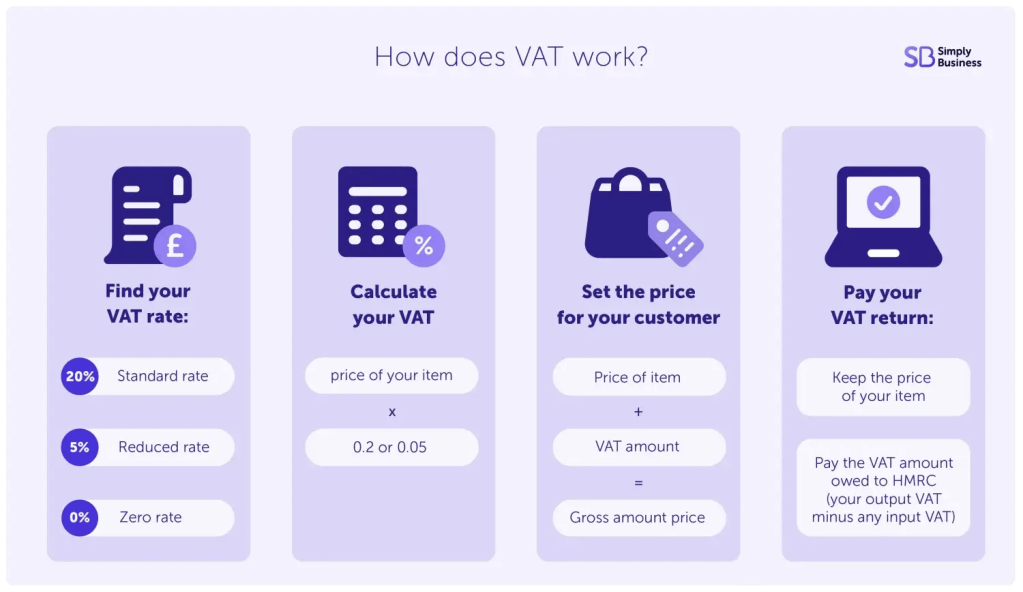
VAT at a glance: The standard VAT rate in the UK is 20% – with reduced rates of 5% and 0% applying to certain goods and services. To add VAT to a net price, multiply by 1.20 (standard rate) or 1.05 (reduced rate).
To find VAT already included in a price, divide the gross amount by six.
If your business is registered for VAT, you need to add this tax to your sale prices and pass it on to HMRC. But working out exactly how much VAT to charge (and how to claim some of it back) can trip up even experienced founders.
This guide breaks down UK VAT rates, the formulas you need for adding and removing VAT, and what you can reclaim on business expenses. Plus a free VAT calculator for you to bookmark.
We’ll also flag the most common mistakes business owners make, and what Making Tax Digital (MTD) means for your VAT returns.
VAT calculator
Use our VAT calculator to add 20% VAT. You just need to input the net amount (the cost of your item) and it’ll calculate:
- gross amount (the cost of your item plus VAT, which should be advertised to customers)
- total VAT amount (how much of the total sale price is owed to HMRC in tax)
To remove 20%, enter the gross amount (the cost of your item including VAT) and it’ll calculate:
- VAT exclusive amount (the net cost of your item)
- total VAT amount (how much is owed to HMRC in tax)
This calculator is based on the standard VAT rate of 20%. You’ll need to calculate differently for the 5% and 0% rates. This is intended as a guide, so it’s always best to speak to a professional if you’re not sure of anything and keep up to date on current VAT rates from HMRC.
What are the current UK VAT rates?
There are three VAT rates in the UK:
| VAT rate | Percentage | What it covers |
| Standard rate | 20% | Most goods and services. It’s been the rate since 2011. |
| Reduced rate | 5% | Specific items like children’s car seats, some health products, and mobility aids for the elderly. |
| Zero rate | 0% | Most food items, children’s clothes, books, newspapers, domestic electricity (temporarily), and prescription medicines. |
Some products and services, like postage stamps, lottery tickets, and insurance, are exempt from VAT altogether. That’s different to the zero rate – exempt goods sit outside the VAT system entirely, while zero-rated goods are still technically VAT-able, just at 0%.
You can read HMRC’s guide to VAT rates on different goods and services for the full list.
Read more: How to pay VAT – a small business guide
How do you add 20% VAT to a net price?
Once you know your VAT rate, adding it to your price is straightforward. Multiply your net price by 1.20 for the standard rate, or by 1.05 for the reduced rate.
For example, if you’re selling a product for £275 at the standard rate, multiply £275 by 1.20 to get £330. Making £330 is the VAT-inclusive price you should advertise to customers.
If you’re selling a children’s car seat for £65 at the reduced rate, multiply £65 by 1.05 to reach a final price of £68.25.
Your business keeps the net amount and passes the VAT portion on to HMRC as part of your VAT return.
Alternatively, you could use our free VAT calculator to work out your VAT.
How do you extract VAT from a gross price? (the one-sixth formula)
Sometimes you need to work backwards – you know the final price a customer paid, but you need to find out how much of that was VAT. This is where the one-sixth formula comes in, and it only applies to the standard 20% rate.
Divide your gross (VAT-inclusive) price by six to find the VAT amount. So if a customer paid £1,080 for a television, £1,080 divided by six equals £180. That £180 is the VAT portion, and £900 is the net sale price your business keeps.
This shortcut works because VAT at 20% always makes up one-sixth of a VAT-inclusive price. For the 5% reduced rate, you’ll need a different calculation – divide the gross price by 21, then multiply by one.
Which business expenses can you reclaim VAT on?
If you’re VAT-registered, you can usually reclaim the VAT you’ve paid on goods and services bought for your business – this is called input VAT. Common eligible expenses include:
- stock and raw materials
- business equipment and software
- professional services like accountancy or legal advice
- fuel and mileage for business travel (with some restrictions)
You’ll need a valid VAT invoice as evidence for each claim – and the expense must relate directly to your business, not personal use. Mixed-use expenses, like a vehicle used for both business and personal trips, usually need to be apportioned.
For founders operating at the edge of the VAT threshold, reclaiming VAT isn’t always straightforward. Gea Krajcar, founder of Soma Yoga in London, explains the dilemma many service-based businesses face:
“It’s scary to grow big. The structure of my business isn’t suitable for VAT as I don’t have much that I can expense. Once I cross the VAT threshold, I need to work so much more to be in the same place. I’m asking myself: do I expand or do I prevent my growth?”
This highlights a real challenge for service businesses with few expenses to offset. If your costs are mostly labour rather than goods, crossing the VAT threshold can feel like a setback rather than a milestone.
Gea isn’t alone in this. According to Simply Business’s SME Insights Report 2026, 24% of small business owners say increasing the VAT registration threshold is the most important action the government could take to support SMEs.
What are the most common VAT mistakes to avoid?
Even well-organised business owners can slip up on VAT. Here are some common mistakes:
- Advertising prices without VAT included. It’s rare that a business should show prices excluding VAT, and doing so can breach advertising rules.
- Using the wrong rate. Mixing up standard, reduced, and zero-rated items leads to under- or over-charging customers.
- Missing the registration threshold. Businesses must register for VAT once their taxable turnover passes the threshold, and late registration can trigger penalties.
- Poor record-keeping. Without accurate VAT invoices, you can’t reclaim input VAT or prove your figures to HMRC.
- Forgetting digital rules on exports. Different VAT rules apply to exports from Great Britain compared to sales from Northern Ireland to the EU, and getting this wrong can cause compliance issues.
How does Making Tax Digital affect VAT compliance?
Making Tax Digital (MTD) requires VAT-registered businesses to keep digital records and submit VAT returns using compatible software, rather than manual spreadsheets or paper records. If you’re still managing VAT through paper invoices or basic documents, now’s the time to move to digital accounting software.
This shift towards digital tax administration isn’t slowing down. From April 2029, the government will make e-invoicing mandatory for business-to-business and business-to-government transactions where VAT is due. An e-invoice is the direct digital exchange of invoice data between accounting systems – sending a PDF or scanned image doesn’t count.
Right now, only 15% of SMEs send e-invoices, and just 24% receive them, with 95% still relying on PDFs or emails. If you invoice other businesses, it’s worth reviewing your current systems well before the 2029 deadline. Read more about what mandatory e-invoicing means for your business.
Keep your VAT calculations simple as you grow
VAT doesn’t have to be complicated once you understand the formulas – multiply by 1.20 to add standard VAT, divide by six to extract it. But as Gea Krajcar’s experience shows, crossing the VAT threshold can genuinely change the shape of your business, especially if you don’t have many expenses to reclaim against.
If you’re approaching the VAT threshold, it’s worth speaking to an accountant about your options before you register, and reviewing your invoicing systems now so you’re ready for mandatory e-invoicing in 2029.
Frequently asked questions
What is the current standard VAT rate in the UK?
The standard VAT rate is 20%, and it applies to most goods and services sold in the UK.
How do I calculate VAT on a price that already includes it?
Divide the VAT-inclusive (gross) price by six. The result is the VAT amount for standard-rate items.
Do I have to register for VAT?
You must register once your taxable turnover goes over the VAT registration threshold set by HMRC. You can also register voluntarily below this threshold if it benefits your business.
Can I reclaim VAT on all business expenses?
No. You can only reclaim VAT on costs that relate directly to your business, and you need a valid VAT invoice as evidence. Personal or mixed-use expenses often need to be split.
What’s changing with VAT invoicing in the future?
From April 2029, e-invoicing becomes mandatory for business-to-business and business-to-government transactions where VAT applies. This replaces PDFs and paper invoices with structured, machine-readable digital data.
More tax guides for small businesses
- How to pay National Insurance when self-employed or running a business
- When is corporation tax due? A guide to UK corporation tax
- Self-employed tax brackets: new thresholds, rates and allowances
- What is Making Tax Digital?
Get personalised insurance for your business
Whether your company needs business interruption insurance, public liability insurance or something else entirely, our award-winning team of insurance experts will work with you to provide the cover you need. Get a quote online, or talk to our expert team on 0330 165 4988 who can walk you through the process.