


Limited company expenses are allowable expenses that your business can claim, helping you reduce your corporation tax bill.
You subtract these limited company expenses from revenue to calculate your company’s profit – and therefore the amount of corporation tax you pay.
By claiming everything you’re entitled to, you can keep your tax bill down and help protect your business’s bottom line.
Limited company expenses – the essentials
If you’ve set up a limited company, your tax-deductible expenses have to be ‘wholly and exclusively’ used for your business. If you pay for something that has a combination of business and personal use – for example you take a work trip abroad and then spend a few extra days on holiday – only the business part of the cost is tax deductible.
But as long as an expense is allowable, you can deduct it from your revenue to calculate your taxable profit.
Generally, any money you spend on entertaining clients or gifts is not allowable, even if it’s a genuine business expense.
It’s important to have a record of all of your limited company expenses, so make sure you keep all of your receipts, invoices, and any other important paperwork.
You need to keep records for at least six years after you’ve filed your tax return, as HMRC could investigate at any point within this timeframe.
Read more: How long to keep tax records
Limited company expenses list
Many of the costs involved in setting up your limited company and keeping it running are allowable business expenses:
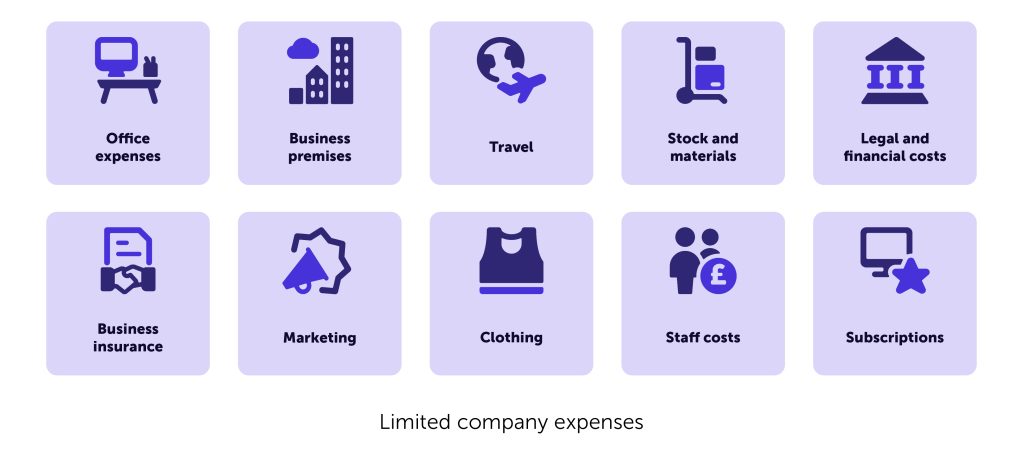
Startup and office expenses
You can expense the fees you pay to get your business off the ground. Any professional services you use, equipment you buy, or general fees you incur can be claimed up to seven years before you start trading.
But when you’re up and running, expenses like rent and utility bills can also be claimed.
Travel expenses
You can expense any travel that your business requires. You can claim for costs related to:
- hotels
- food for overnight stays
- parking
- toll or congestion charges
- vehicle insurance
- vehicle maintenance and repairs
If you claim for fuel that you’ve paid for with personal cash, you can claim 45p a mile for the first 10,000 miles and then 25p for every mile after that. For motorcycles, you can only claim 24p a mile. You can also claim 20p a mile for travel by bicycle.
Marketing costs
Most things you spend on advertising your business count as a company expense. This includes expensive campaigns, monthly software subscriptions, social media ads, and affiliate marketing.
Staff costs
You can claim for most costs related to your employees. Salaries, uniforms, and equipment can be claimed but also bigger scale events like staff parties can be claimed up to £150 a person.
If your staff look at screens for long periods, you can expense the cost of their eye tests and prescriptions.
Legal fees
If you hire professionals like lawyers or accountants, you can expense the fees you pay them.
You can do this at any stage of your business journey. Whether you need long-term legal support or short-term advice, both count as a company expense.

Business insurance
Helping to protect your business with business insurance is an important cost that you can fortunately expense. Any cover applies. This includes employers’ liability insurance, public liability insurance, tools insurance, and contents insurance.
Promotion
What about capital allowances?
It’s a bit different if you buy an asset for your business. If you buy something that you’re going to keep and use in your business, like a piece of machinery or a work van, you can claim capital allowances on your tax return.
Most limited companies can now claim ‘full expensing’, which means you can deduct 100% of the cost of qualifying plant and machinery from your profits straight away.
You can also use your annual investment allowance (AIA). The government has permanently set the AIA at £1 million, meaning you can deduct the full value of qualifying items up to this amount before you pay tax.
What about limited company expenses and employees?
If you provide benefits or expenses to your employees, you may have to tell HMRC and pay tax and National Insurance on them. This rule also applies to you if you are a company director.
Check the list of employee expenses and benefits on the government website for the rules about each type of cost.
If your employees pay for things during their work, ask them for receipts so you can reimburse them. You can then include these purchases when calculating your tax deductible expenses.
Remember that normal commuting costs aren’t tax deductible, but you can claim for other staff travel costs, for example when an employee visits a client or goes to a conference.
It’s a good idea to put an employee expenses policy in place. This tells your employees exactly what you will reimburse, how they need to claim it, and when you will pay them back.
Tax can be complicated, and you can face fines if you make a mistake on your tax return. Look at the guidelines on the government website and look for professional advice from an accountant if you’re not sure.
Useful guides for small businesses
- Best accounting software for small businesses
- Making Tax Digital – a simple guide
- Changing from sole trader to a limited company
- Is public liability insurance tax deductible?