

A record number of buy-to-let (BTL) companies were set up in 2025, according to new research from estate agency Hamptons.
Analysis of Companies House data shows that the 66,587 companies set up to hold buy-to-let properties was second only to those offering mail order services.
Find out why more landlords than ever before are choosing to incorporate.
Almost 450,000 buy-to-let companies in the UK
2025. In the 10 years since Section 24 tax changes were announced, the number of property companies has increased nearly five times from the 91,278 recorded in 2016.
Last year was another record for the number of new limited companies being set up by landlords (66,587), surpassing the previous record of 61,517 in 2024.
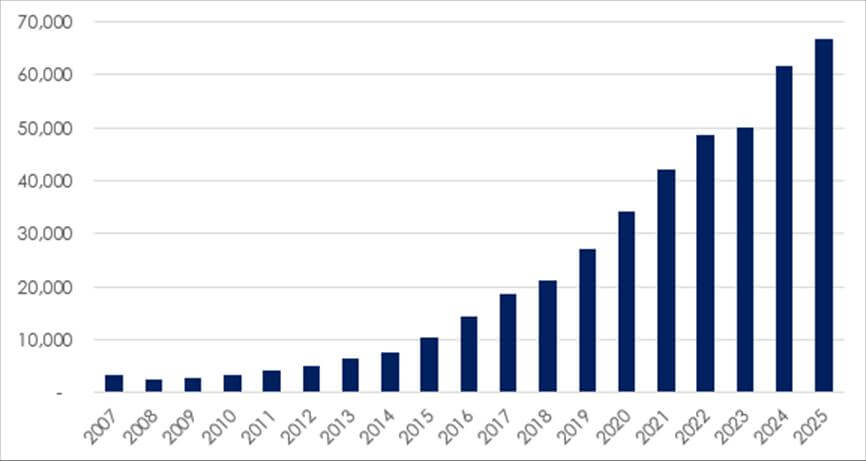
The number of new companies peaked at 6,493 in September 2025, the highest monthly figure on record. And there were more than 5,000 BTL companies created in 10 out of the 12 months last year.
This momentum has carried into 2026, with 5,922 new buy-to-let limited companies set up in January, an 11 per cent rise year-on-year.
The 443,272 buy-to-let companies hold approximately 1.5 million rental properties.
Read more: Setting up a buy-to-let limited company – a guide for landlords
New and younger landlords prefer limited companies
Separate research from Paragon shows that new and younger landlords are opting to incorporate ownership of their rental properties.
A survey of 500 landlords found that landlords aged between 25-34 hold 57 per cent of their properties in limited companies.
This falls to 46 per cent among 35-44 year olds and broadly declines as landlords’ ages increase.
What’s more, landlords who have been in the market five years or less hold 80 per cent of their properties in limited companies.
This halves to 40 per cent amongst landlords with between six and 10 years’ experience and drops further to 21 per cent for those who have been letting between 11 and 20 years.
Landlords who have been letting properties for 21 years or more hold just 16 per cent of their properties in BTL companies.
Paying corporation tax ‘increasingly attractive’
Frozen tax thresholds and market challenges have encouraged a surge in rental property companies, according to Hamptons’ Head of Research Aneisha Beveridge.
“While the tougher tax treatment introduced in 2016 sparked the initial move into corporate structures, five years of frozen personal allowances, combined with the impact of higher mortgage rates, which company landlords can fully offset against their tax bill, have fuelled the more recent surge.
“As more landlords find themselves pulled into the 40 per cent income tax bracket, paying corporation tax at 19 per cent or even 25 per cent has become increasingly attractive,” she said.
Why are more landlords setting up limited companies than ever before?
Since 2020, landlords have no longer been able to claim buy-to-let mortgage interest as an expense on their income tax bill. Instead it has been replaced with a 20 per cent tax credit.
This has meant increased tax bills for many landlords, particularly those that pay tax at a higher rate.
As a result, landlords have transferred ownership of their properties to limited companies to pay corporation tax at between 19 per cent and 25 per cent instead of income tax.
But setting up a company isn’t the best option for all investors. “For landlords who earn no income beyond their rents and remain lower-rate taxpayers, owning property in personal names can still be the better option, particularly as above-inflation increases have pushed up Companies House filing fees,” Beveridge explained.
What are the barriers to incorporation?
Over half (57 per cent) of landlords who don’t own properties through a limited company see costs such as capital gains tax and stamp duty as the primary obstacle, according to Paragon’s study.
Other reasons for not going down the BTL company route include:
- advised not to by a tax adviser or accountant
- lack of mortgage options and poor rates
- lack of knowledge about the subject
- lack of support to guide them through the process
More guides for landlords
- New energy efficiency rules for rental properties
- 5 buy-to-let tax changes landlords need to know in 2026
- Landlords warned as local councils crack down on compliance
- Tax on rental income – a complete guide to landlord tax