

What’s changing with late payments
- new late payment laws look to set terms set to a maximum of 60 days for big businesses supplying small firms
- new investigatory powers for the Small Business Commissioner mean you can report businesses with poor practices
- multi-million pound fines for repeat late payment offenders
- mandatory payment terms, clearer reporting guidelines, and interest, meaning compensation for small suppliers if invoice payment deadlines are missed
- we spoke to a finance expert to learn more about what the latest on late payments means for the self-employed
A new Bill to tackle late payments has officially been brought forward to Parliament, after it was confirmed in the King’s Speech earlier this month. The government is taking aim at poor payment practices by proposing fines for big businesses and repeat offenders as part of these sweeping reforms.
In what they’re calling “the toughest crackdown on late payments in 25 years”, big businesses will now be mandated to pay within 60 days when working with smaller suppliers.
But what does this mean for small businesses and the self-employed? And does the proposed legislation go far enough?
Reforms: at a glance
- payment terms set to a maximum of 60 days for big businesses supplying small firms
- new investigatory powers for the Small Business Commissioner, so you can report businesses with poor practices
- multi-million pound fines for repeat offenders
- mandatory payment terms, clearer reporting guidelines, and interest, meaning compensation for small suppliers if invoice payment deadlines are missed
The late payment crackdown was first announced on 24 March but a Bill was formally introduced to Parliament on 18 May 2026.
The Commercial Payments Bill builds on existing late payment laws. The Small Business Commissioner has said this will give the government the strongest legal framework on late payments in the G7.
You can keep track of the Bill as it makes its way through Parliament. It becomes law once it receives ‘Royal Assent’. And keep checking back to the Knowledge centre for the latest small business news.
Watch our quick video to understand what’s changing with late payments and what exactly it means for small business owners like you.
Get paid in 60 days
Under the new proposals, big businesses supplying small firms will have to pay invoices in a maximum of 60 days – or face penalties and interest charges.
FSB Policy Chair Tina McKenzie said: “The new laws will finally bring a stop to big businesses using their small suppliers as sources of free credit.
“For the first time, audit committees and boards will question and challenge poor payment performance, publish it in annual reports for all to see, and put it right. Paying in 60 days is not prompt – but strengthening that as the absolute maximum cap after years of dithering is a good step towards encouraging payments in 30 days across all supply chains.”
However, ‘pay in 60 days’ only applies to larger firms and assumes that late payments are mostly a problem with bigger businesses working with small ones. So it’s possible that this only goes part of the way to solving the problem.
Fines and mandatory interest on late payments
With the Bill actively progressing through Parliament, the Small Business Commissioner is set to gain new powers to investigate poor payment practices and will be able to issue multi-million pound fines to the businesses that persistently fail to pay on time.
And all commercial contracts will have to include a statutory interest on late payments, set at 8% above the Bank of England base rate. This has been the case for limited companies since the last late payment legislation was passed in 1998, but the law has allowed businesses to negotiate their own interest clauses and lower interest rates.
The government hopes that making an interest clause non-negotiable in the eyes of the law will go some way to support small businesses and the self-employed who are regularly facing cash flow challenges with suppliers not paying on time.
Read more: How write an invoice and free templates
Business Secretary Peter Kyle said: “We are unveiling the strongest, most robust changes to payment laws in over a generation – laws that will transform the fortunes of small businesses for years to come and make their day to day lives much easier.”
These reforms are expected to be phased in later in 2026. And in the next five years, the government hopes to reduce payment terms to 45 days.
4 steps the self-employed can take today
- Inform the Small Business Commissioner if you’re dealing with a business that’s persistently failing to pay on time – the law is giving them new powers to investigate.
- You can add interest clauses to your payment terms – and the new legislation will back you up.
- Invoices must be paid in 60 days as a maximum – but there’s no reason why you can’t set your payment terms to 30 days as standard.
- Big businesses can only raise invoice disputes if it’s within 30 days of receiving your invoice – so make sure you send invoices promptly after completing the work.
86 hours a year wasted on chasing payments
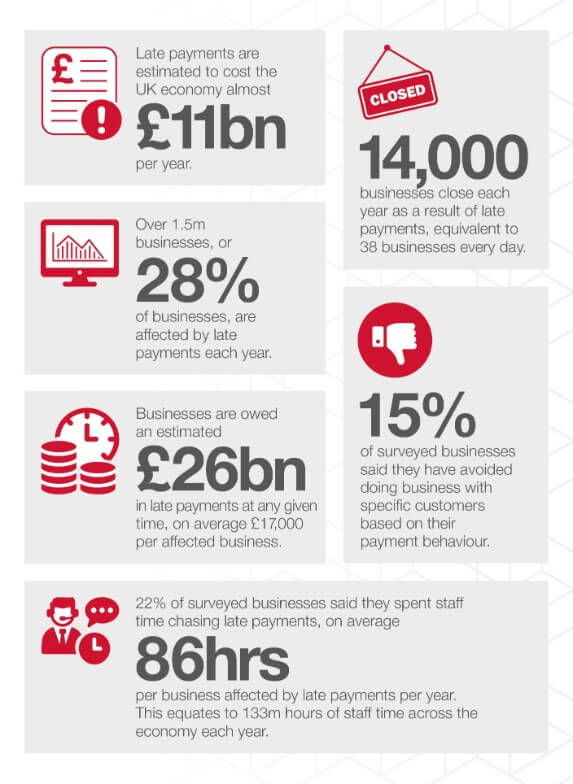
Small business owners are spending 86 hours a year on average chasing late payments, according to the government’s late payment consultation published in March 2026.
With the introduction of the Bill to Parliament, Prime Minister Keir Starmer said: “Too many small business owners are spending hours chasing money they are already owed and when payments don’t come through, the cost is personal. It’s about whether you can pay your staff, keep the lights on, or invest in your future.
“Today we’re changing that with the toughest action on late payments in a generation, so small businesses get paid on time and get the backing they need to grow, create jobs and serve their communities.”
Emma Jones CBE, the UK’s Small Business Commissioner said: “Currently late payments cost the UK economy £11 billion a year with founders spending over 86 hours chasing overdue invoices. I am committed to get money moving in the economy and free up small businesses time to grow and thrive. Ending late payments will be critical to realising this goal and this Bill is on the path to achieve this.”
A cultural shift is needed too
Tom Lamb is Head of UK for the embedded invoice financing platform Aria and has a background in fintech. Following news of the government’s proposals, he shared that “late payments have become a cultural problem, normalised and dismissed as just the way things are for small business owners.”
Lamb identified that for many business owners, chasing payments can feel difficult – even if the law backs them up.
“Chasing payments is never a pleasant thing to do[…] When it’s your biggest client, the fear of losing that contract quietly wins out. Most suppliers decide the contract isn’t worth risking, so they say nothing, and wait.
That silence has become the norm.”
This correlates with previous research on the impact of other late payment initiatives from the government. Simply Business found that only 3% of business owners have seen a reduction in late payments since the Fair Payment Code was introduced in October 2024. The survey of 900 small business owners also found that for 12% of respondents, the problem had actually got worse.
When asked if he thought the new Commercial Payments Bill will go far enough and bring about real change for small business owners, Lamb said: “Even though the new legislation will give businesses legal backing to charge interest on overdue invoices and a Commissioner with real enforcement powers, no law can make a supplier feel comfortable chasing their biggest client.”
‘The best defence will be preparation’
Sharing his final thoughts, Lamb urged small businesses to prepare for the possibility of late payments to help minimise the impact if it happens.
He said: “The best defence will be preparation, agreeing to payment terms before any work starts, not after. If a client typically pays in 60 days, either price it into your quote or ask for a deposit. That way, when a payment runs late, you’re not waiting it out in silence, you’re able to point to something you both agreed to.”
Want to share your experience on late payments and other small business issues? Subscribe to our newsletter to be the first to hear about our annual SME Insights survey. And in the meantime, we’ll bring you the most important news updates for the self-employed. Keeping it practical, easy to understand, and relevant to you.
More small business guides
- Legal obligations of a business you might not know about
- Could AI help you chase unpaid invoices?
- Is Making Tax Digital replacing Self Assessment?
- Stolen pint glasses cost pub landlords millions