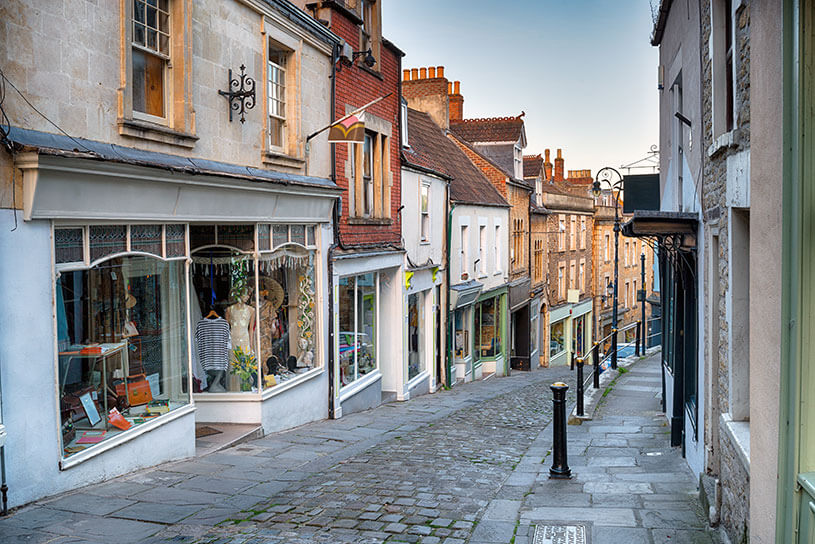

The UK high street is evolving as independent businesses adapt to new business rates relief brought in by the government on 1 April, rising costs, and artificial intelligence (AI) adoption.
Rather than being a “do or die” moment it can be seen by many small businesses as an opportunity to adopt leaner, more flexible cost structures and pivot to niche demand. For example, offering specialist or premium products and filling in the gaps left by big UK high street chains, and that’s just the start.
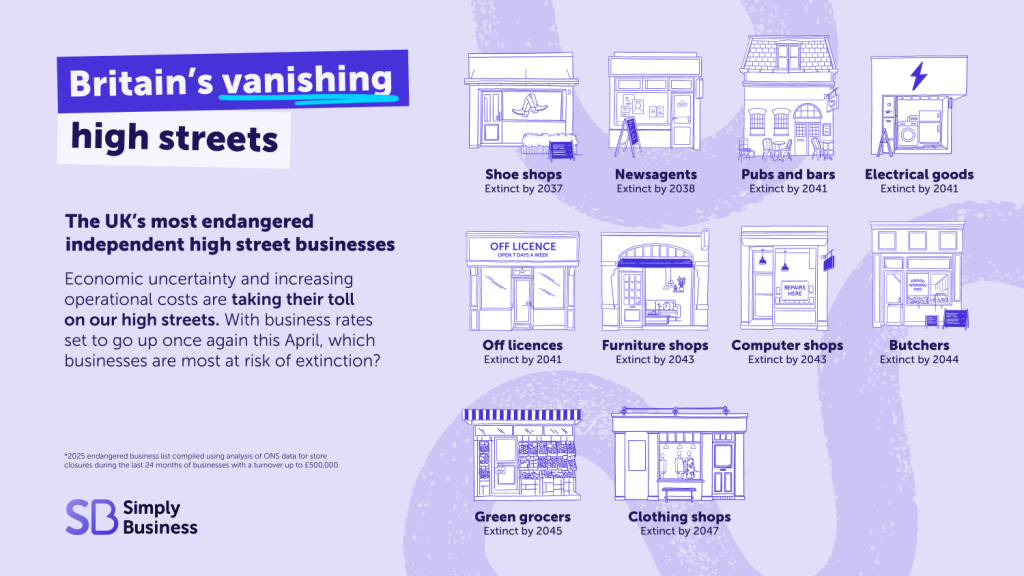
Research from Simply Business found that some high street shops as we know them could disappear forever if they continue closing at current rates. From shoe shops to pubs, the declining high street should be a wake up call for independent businesses to adapt. But why is this happening and what can be done?
Time to start ‘future-proofing’
There has been a dramatic change in consumer shopping habits intensified by the Covid pandemic five years ago, resulting in more consumers doing their shopping online.
According to the British Retail Consortium (BRC), online sales currently account for 28.3% of retail sales (as of December 2025). But reports have suggested this could reach 50% by 2028.
This is surely a red alert for independent businesses to start future proofing their UK high street offering.
Build community hubs
One way of doing this would be to act less like retailers and more like community hubs, building events, collaborations, and loyalty schemes.
Pubs and bars could also benefit from becoming more community focused and adapting to changing consumer habits. There’s a growing trend for people to combine socialising with saunas or exercise with experiences – and it’s a community that people are looking for.
According to UK Active, a trade body that represents most of Britain’s fitness operators, young adults prefer to go to the gym rather than the pub. The data shows 11.5 million people aged 16 and over now belong to a gym in the UK, a rise of 1.6 million from 2022.
Failure to address the needs of the local community might lead to pubs and bars facing extinction by 2041, according to the analysis from Simply Business and data from the Office for National Statistics (ONS).*
From providing space for families and pets to ethically sourced food and drink, people are looking for pubs that align with their lifestyle rather than counter it.
And with groups like the Mikkeller Running Club Brighton that tours independent pubs for a post-run pint and fitness venues that team up with local cafés to offer discounts, the possibility for community opens up.
AI adoption
Small businesses on the UK high street could evolve by using AI for marketing, stock management, and customer insights, automating administration to cut costs and personalising customer experiences.
There’s also the use of employing social media as part of digital-first strategy, physical second.
Independent clothing shops can consider livestreaming events, for instance a fashion show or creating a virtual shop window for remote customers.
Adapt to changing trends
Independent businesses on the UK high street will need to be knowledgeable about the latest trends in their sector and beyond – adapt their business accordingly or face extinction.
Clothing shops could face extinction by 2047 according to the data from Simply Business.*
And it’s not difficult to understand why due to the competition from online fast fashion brands like Shein or Temu who are producing high volume, trend driven clothing at low prices.
What can independent clothing retailers do to adapt to the competition? If they can’t match the volume of clothing production, what they can do is dare to be different. Pick up on the latest trends, from sustainable and handmade fabrics to 90s nostalgia or vintage styles to plug the gap.
‘Out of step with reality’
Tom, a furniture maker from Leeds, continues to operate from a home workshop, selling via social media and word-of-mouth. This isn’t surprising considering the recent change to business rates relief, rising energy costs, and buying tools for his business.
The furniture maker noted that while a physical space would enhance credibility, the financial commitment currently feels “out of step with reality.”
Financial pressure of a premises
Sophie, a beauty therapist from Plymouth has chosen to adapt her business model. She had initially planned to open a small treatment room after qualifying in aesthetics. However, after reviewing the combined costs of rent, utilities, and business rates, she made the decision to operate as a mobile therapist instead.
While this has limited her capacity in the short term, it has allowed her to build a loyal client base without the immediate financial pressure of fixed premises. She described the decision as “slower, but safer.”
There is help out there
Fast-forward two decades and the consumer might be greeted with a more lean version of the UK high street if independent businesses act now and adapt to change.
But help is out there. The government has promised small business support for those most at risk from the retail, hospitality and leisure sectors (RHL). Pubs will get a 15% cut to new business rates bills from April followed by a two-year real-terms freeze, as well as a review into the method used to value them for business rates.
Simply Business is also offering a range of solutions to support 10,000 small businesses by 2030 through the Big Dreams Project.
*Analysis based on the number of high street business premises trading in 2023 compared to 2025 with an annual turnover of £500,000 or less (Office for National Statistics)
Guides for small businesses
- Small business grants: everything you need to know
- The real cost of stealing a pint glass
- Invisible threats to small businesses (and what to do about them)
- Best accounting software for small businesses – get MTD ready
Ready to set up your cover?
As one of the UK’s biggest business insurance providers, we specialise in public liability insurance and protect more trades than anybody else. Why not take a look now and build a quick, tailored quote?