


Quick answer: Self-employed people can claim allowable expenses – costs that are exclusively for business use – to reduce their taxable profit. Common categories include office costs, travel, marketing, business premises, staff costs, and insurance. Claiming everything you’re entitled to means you only pay tax on your actual profit.
If you’re self-employed, every pound you spend running your business could reduce your tax bill. But HMRC has strict rules about what counts – and getting it wrong could mean paying more tax than you need to, or worse, facing a fine.
This guide is aimed at sole traders and self-employed people. It also applies to company directors in some cases, although the process for limited companies works slightly differently.
What are allowable expenses?
Allowable expenses are costs exclusively for your business. You subtract them from your turnover to work out your taxable profit – which is the amount HMRC actually taxes you on.
Here’s a simple example: if your business earns £25,000 in a tax year, but you have £5,000 in allowable expenses, you only pay tax on £20,000. That could save you hundreds of pounds, depending on your tax rate.
This video covers everything you need to know about how you can reduce your tax bill by explaining the golden rule of expenses: if you use it for work, then you can claim it. Watch below for examples of expense claims – and one big tip you can’t forget.
Get your free guide on self-employed expenses
Download your free in-depth guide to claiming allowable expenses on your Self Assessment. Why not save it and refer back to the guide when completing your tax return?
What expenses can I claim on my Self Assessment tax return?
HMRC groups allowable expenses into several categories. Here’s what you can and can’t claim in each one.
Watch the video below for some quick tips on the self-employed expenses process.
| Expense | Allowable (you can claim) | Not allowable (you can’t claim) |
| Travel | Parking and fuel costs for work journeys | Travel costs for commuting from home to your main place of work |
| Office expenses | Stationary and supplies such as printer cartridges and pens used for work | Stationary bought for personal use |
| Marketing | Promotional materials or social media ads | Costs for entertaining clients |
| Working from home | A portion of your utility bills, based on how much of your home you use for business | Mortgage repayments or rent |
| Business premises | Rent and utility bills | The cost of buying a premises or building work |
| Subscriptions | Memberships to trade bodies and subscriptions to journals relating to your business | A Netflix subscription for personal use |
| Legal and financial costs | Professional costs for an accountant or interest on business loans | Fines for breaking the law or bad debts |
| Stock and materials | Stock or materials used for your business | Materials bought for private use |
| Business insurance | The cost of insurance such as public liability or professional indemnity | Personal insurance, such as home insurance |
| Staff costs | Employee salaries and pension contributions | The cost of employee fines, such as parking tickets |
You can read the full list of self-employed expenses on the UK government website.
How to calculate self-employed allowable expenses
Your tax records are the starting point for working out your allowable expenses. The figures will be unique to your business, so accurate records make all the difference. In practice, it’s a case of adding up the expenses from your bills and receipts. Keep every one – if you don’t, you could miss out on a claim.
How you calculate your expenses also depends on your accounting method. With cash basis accounting, you record expenses when you pay them. With traditional accounting, you record them when you receive the bill or receipt.
When you complete your tax return, you may get the option to enter a single figure for your allowable expenses, or to give a detailed breakdown. If you choose a single figure, you still need to work out your expenses accurately and keep a record of your workings in case HMRC queries them.
Hold on to your receipts and other proofs of purchase too, as you may need to produce them during a tax investigation. HMRC says you should keep tax records for at least five years after the 31 January deadline of the relevant tax year.

Business insurance is an allowable expense
Premiums for business-related cover, such as public liability insurance or professional indemnity insurance, count as allowable expenses. Personal insurance policies don’t.
Promotion
What are the most common expenses mistakes self-employed people make?
Knowing what you can claim is one thing – but avoiding these common pitfalls is just as important.
- Claiming personal costs as business expenses. HMRC requires that expenses are wholly and exclusively for business use. Mixing personal and business costs can lead to an investigation and a fine.
- Forgetting to record purchases. If you don’t keep a record, you can’t claim it. Use a receipt tracking app or accounting software to log expenses as you go.
- Misunderstanding working from home rules. The rules here are more nuanced than people expect. Take time to read government guidance on HMRC simplified expenses flat rates before submitting your return.
- Not claiming everything you’re entitled to. Missing whole categories of expenses means you pay more tax than you need to. Run through the full list each year before you file.
- Not keeping records for long enough. HMRC can investigate your tax return for up to 20 years after the filing deadline. Keep all invoices and receipts for at least five years from the 31 January submission deadline.
How do I record and claim expenses on my Self Assessment return?
Good record-keeping is the foundation of a clean tax return. HMRC expects you to keep accurate records of all income and expenses throughout the tax year.
Under Making Tax Digital (MTD) for income tax – which was phased in from April 2026 – many self-employed people and landlords will need to keep digital records and submit quarterly updates to HMRC. It’s worth getting into the habit of digital record-keeping now.
When it comes to filing your self assessment, you enter your total allowable expenses against each category. HMRC then calculates your taxable profit automatically.
The UK government’s legal requirements for keeping tax records guidance can help you stay compliant.
Start claiming what you’re owed
Claiming all your allowable expenses is one of the simplest ways to reduce your tax bill legally. The key is knowing what qualifies, keeping good records throughout the year, and double-checking you haven’t missed any categories before you file.
If you’re not sure whether a particular cost qualifies, HMRC’s guidance is a good starting point – or speak to an accountant who specialises in self-employed tax.
Allowable expenses FAQs
What expenses can I claim as self-employed on my tax return?
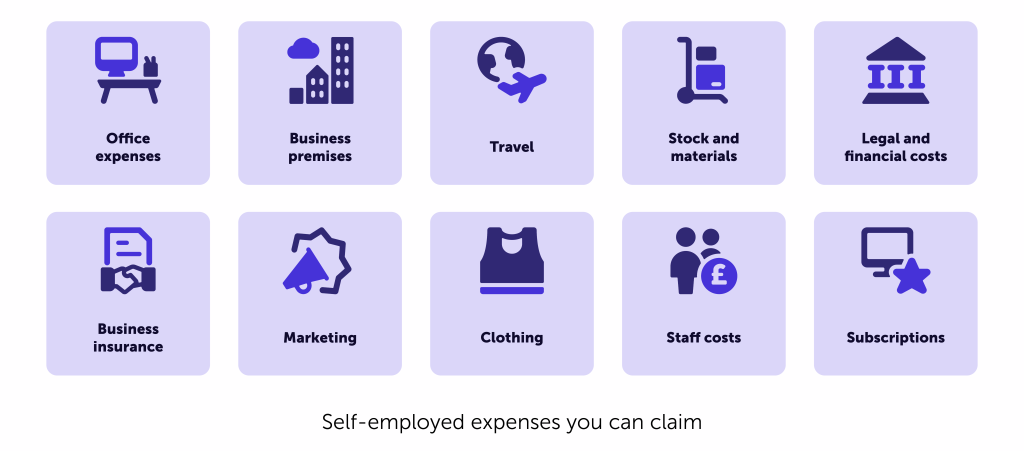
Self-employed people can claim allowable expenses in categories including office costs, business premises, travel, stock and materials, marketing, legal and financial costs, business insurance, staff costs, and subscriptions. Each expense must be wholly and exclusively for business use.
Can I claim my phone bill as a self-employed expense?
You can claim your phone bill as an allowable expense, but only the business-use portion. If you use your phone for personal and business calls, you’ll need to estimate the percentage used for work and claim that share only.
Can I claim travel expenses on my Self Assessment?
Yes. Business travel costs – including fuel, parking, and public transport – are claimable. Commuting from home to your regular place of work isn’t allowable.
How much can I claim for working from home?
You can claim a proportion of household costs like heating, electricity, and broadband, based on how much of your home you use for business and for how long. HMRC also offers a simplified flat rate, which some people find easier to use.
Do I need receipts to claim expenses on my tax return?
Yes, HMRC expects you to keep records to support all expense claims. Without receipts or records, you won’t be able to justify a claim if HMRC investigates. Keep all records for at least five years after the 31 January deadline.
Can I claim business insurance as a self-employed expense?
Yes, premiums for business-related insurance – such as public liability or professional indemnity insurance – count as allowable expenses and can be deducted from your taxable profit.
What expenses can’t I claim on my Self Assessment?
You can’t claim personal costs, commuting, client entertainment, mortgage repayments, fines, or anything not used wholly and exclusively for your business.
Tax can be complicated, and you can face fines if you make a mistake on your tax return, so look at the guidelines on the government’s website and seek professional advice if you need it.
More guides to help you with your taxes
- How to amend a Self Assessment tax return
- How to register as self-employed with HMRC
- HMRC Time to Pay – how to set up an HMRC payment plan
- Is public liability insurance tax deductible?